
Ashlar Limestone Paving in Melbourne: Why the Dry-Lay Process Matters
A pattern that looks effortless when it's right, and obviously wrong when it isn't
Ashlar paving is one of those finishes that reads as quiet luxury when it's done properly. Different sized rectangles fitted together without a repeating grid, joints lining up cleanly across the whole surface, the eye taking it in as a single considered piece of work rather than a tiled floor. It's a pattern that appears in the best courtyards across Toorak, South Yarra, East Melbourne, Prahran and Carlton, and it's been used in premium landscape construction for centuries.
It's also a pattern that goes wrong easily. An ashlar layout that isn't planned properly looks random in the bad sense, with misaligned joints, awkward sizing, and visual rhythm that doesn't settle. Once the pavers are set on adhesive, those problems are permanent.
This post is about how proper ashlar paving actually gets built, why the dry-lay process matters so much, and what makes limestone the right material for courtyards across inner Melbourne. It's a companion piece to our recent post on sub base preparation, picking up where that one left off, with the limestone going down on top of the slab.
What ashlar paving actually is
Ashlar is a stone-laying pattern that originated in classical masonry, traditionally used for cut stone walls where blocks of varying sizes were fitted together to form a strong, visually balanced surface. The same principle applies to paving. Rectangular stones of different sizes are arranged so that joints stagger naturally, no single grid emerges, and the overall composition reads as deliberate rather than mechanical.
A typical ashlar paving layout will use three to five different paver sizes, often in ratios designed to fit together cleanly across a given surface area. The skill is in arranging those sizes so that:
- No joint runs more than two pavers in a straight line (avoiding what masons call a "lazy joint")
- Sizes balance across the whole surface rather than clustering in one area
- The pattern reads as continuous and considered rather than random
- Cuts at the perimeter are minimised, and where they exist, they're consistent
Done well, ashlar paving looks timeless. It works alongside heritage architecture without feeling pastiche, and it complements modern design without feeling cold. It's why architects and landscape designers across Melbourne keep specifying it for premium residential projects.
Done poorly, it looks like a pile of pavers that didn't quite fit. There's no middle ground.
Why dry-laying is non-negotiable
Dry-laying means setting out the entire paving layout on the prepared sub base without adhesive, checking the pattern, adjusting individual pavers, and only fixing them down once the layout is right. It's the step that separates premium paving work from rushed work, and it's particularly critical for ashlar patterns.
Here's what dry-laying actually allows:
Pattern verification. With an ashlar layout, you can't tell whether the pattern will read correctly until you see most of it laid out. Working paver by paver from one corner without dry-laying first leads to problems at the opposite end where the sizes no longer balance, and by then there's no way to fix it without lifting everything.
Cut planning. Edges and obstacles like drainage pits, walls, and steps all require cuts. Dry-laying lets you plan those cuts in advance, position the full-sized pavers to maximise visual impact, and put the cuts where they're least visible.
Joint alignment. Ashlar isn't a grid, but it still has rules. Joints that should align across the surface need to align. Joints that should stagger need to stagger. Dry-laying is the only way to verify this visually before committing.
Material sorting. Natural stone varies. Even within a single delivery of limestone pavers, there'll be variation in colour, shade, and surface texture. Dry-laying lets you sort and distribute that variation evenly across the surface rather than ending up with all the darker pieces in one corner.
Replacement of damaged pieces. Pavers occasionally arrive with chips, cracks, or surface defects that aren't visible until they're laid out. Dry-laying catches these before they become a permanent problem.
The contractors who skip dry-laying are usually the ones working on price rather than quality. It takes longer to dry-lay an entire surface and then fix it down than it does to lay straight onto adhesive and adjust as you go. The time difference can be a full day on a typical courtyard, sometimes more.
That time investment is exactly what produces a result that holds up visually for decades.
Why limestone is a strong choice for Melbourne courtyards
Limestone has been a premium paving material in Melbourne for as long as the city has been building high-end residential gardens. Several reasons:
Visual softness. Limestone has a natural warmth and tonal variation that hard stones like granite or bluestone don't share. It softens the look of a paved area, which matters for courtyards designed to feel like outdoor living spaces rather than utility surfaces.
Workability. Limestone cuts cleanly and consistently, which makes it well suited to patterns like ashlar where multiple sizes need to fit together precisely. The cuts come off the saw with clean edges that hold up to scrutiny.
Weathering character. Unlike some pavers that look new for two years and then start to show wear, limestone weathers gracefully. It develops character with age, picking up subtle patina from rain, sun, and use, without losing its structural integrity.
Climate compatibility. Australian limestone (and good imported alternatives) handles Melbourne's wet-dry climate well when properly sealed and laid on a stable sub base. The thermal mass helps it stay cool underfoot in summer, and it doesn't crack or spall through normal seasonal cycles.
Architectural fit. Limestone works alongside both the heritage brick architecture common across inner Melbourne and the more modern designs being built in newer growth corridor developments. It's one of the few stones that genuinely fits both contexts without compromise.
There are limestone alternatives that work well too. Travertine, bluestone, and granite all have their place depending on the project. For most premium courtyards in Toorak, South Yarra, East Melbourne and Prahran, limestone hits the right balance of warmth, durability, and visual quality.
The full process, from concrete to final finish
For the recent courtyard project we've been documenting across our Monday posts, the sequence ran like this. It's a useful reference for anyone planning similar work.
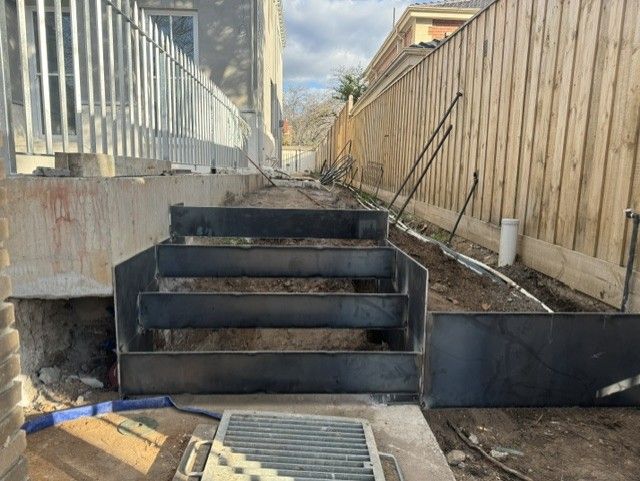
Stage one: sub base. Timber formwork built, reinforcement mesh laid on bar chairs, concrete slab poured with proper drainage falls. Covered in detail in our previous blog post.
Stage two: cure. The slab cured for around a week before any pavers went near it. Concrete reaches usable strength at seven days and full strength at twenty-eight. Quality jobs respect this.
Stage three: pre-laying check. Slab levels verified, drainage points cleaned out, surface swept and prepared for adhesive. Any irregularities in the slab surface addressed before the pavers go down.
Stage four: dry-lay. Full ashlar pattern set out across the entire surface using all the actual pavers from the delivery. Pieces sorted for colour and quality, sized layout balanced across the area, cuts planned at the perimeter and around any drainage points.
Stage five: fixing. Pavers lifted in sequence, tile adhesive applied to the slab in workable sections, pavers set back in the exact positions established during the dry-lay. Levels checked across the surface as each section is set.
Stage six: joints and finishing. Once the adhesive has cured, the joints between pavers are pointed with the appropriate jointing compound. Surface cleaned, sealed if required by the paver type, and the courtyard left to settle into use.
The total time investment for a courtyard of this scale is typically two to three weeks from formwork to finished surface. The cure time alone accounts for a meaningful portion of that. Anyone quoting significantly less for premium paving on a reinforced slab is either cutting steps or not doing them properly.
What separates premium landscape construction from regular paving
There's a meaningful gap between what most paving contractors do and what proper landscape construction involves. The difference comes down to a few things.
Engineering input where it matters. Slab thickness, reinforcement spec, drainage design, and structural elements like retaining walls or steps all benefit from proper engineering consideration rather than guesswork. Larger or more complex projects warrant this input explicitly.
Material relationships. Working with quality stone over decades builds relationships with suppliers who can deliver consistent material, source specific sizes, and supply replacements if anything is damaged in transit. These relationships matter when you need a particular limestone tone or a non-standard size to make a pattern work.
Cross-trade coordination. Premium courtyards rarely involve just paving. Irrigation, drainage, lighting, planting, and sometimes earthmoving all need to coordinate with the paving stage. A landscape construction team that can handle all of these internally produces a more integrated result than one that subcontracts each element.
Craftsmanship at the detail level. Pattern layout, joint widths, edge details, perimeter cuts, drainage pit framing, step nosings. These are the small decisions that separate work that looks excellent from work that looks fine. They take experience to get right consistently.
CHS has been building landscapes across Melbourne since 1995. Our team approach to landscape construction brings together horticultural knowledge, civil construction experience, and detailed finish work under one umbrella, with projects ranging from small residential courtyards to commercial work valued in the hundreds of thousands. The same standards apply across the range.
What to think about if you're planning a paving project
A few practical points for anyone considering a paving project for their own property:
Specify the sub base, not just the surface. When discussing a paving project with a contractor or designer, the conversation should cover what's going under the pavers, not just what colour the stone is. If the sub base detail isn't being discussed, ask why.
Choose your stone before finalising the design. Stone selection affects pattern options, sizes available, joint widths, and overall visual feel. It's worth visiting a stone yard, handling samples, and seeing the material in different lighting before committing.
Plan for the cure time. Reinforced concrete sub bases need to cure before pavers go on. This isn't negotiable, and any timeline that doesn't allow for it is a problem. Build the cure period into your project planning.
Ask about dry-lay process. Specifically for patterns like ashlar, ask the contractor how they handle layout. If the answer doesn't include a clear dry-lay step, that's a flag.
Look at past work. Photos help, but if possible, visit past projects in person. A courtyard that's been in place for five or ten years tells you much more about a contractor's work than something just finished. Our projects portfolio gives some sense of the range and quality of work we deliver.
The long view, again
The thread connecting both of these posts, the sub base post and this one, is the same idea expressed differently. Premium landscape construction is about getting the unseen parts right so that the visible parts hold up over time.
A reinforced concrete slab you'll never see again once the pavers are down. A dry-lay process that adds a day to the project but ensures the pattern reads correctly. Cut planning that puts the full-sized pavers where they're most visible and the cuts where they're least. Cure time that respects what concrete actually needs. Material selection that holds up to thirty years of weather rather than just looking good for the photo.
None of this is glamorous. All of it is what separates work that lasts from work that doesn't.
If you're planning a courtyard, paving project, or any other landscape construction work across Melbourne, get in touch to discuss the specifics.