
Trench Safety in Melbourne: Why Stepped Battering Beats Shoring on the Right Site
Anyone searching for trench safety in Melbourne has probably pictured timber shoring, steel props braced wall to wall, holding a trench open while someone works below. That is one way to do it. It is not the only way, and on plenty of civil earthworks jobs it is not even the best way.
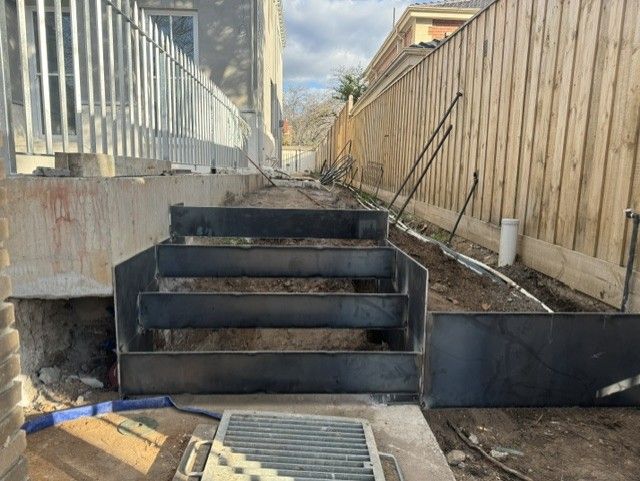
On a recent job on Melbourne's fringe, the CHS team was laying pipework in a trench with real depth to it. Instead of shoring, the walls were cut back in a stepped batter, a technique that solves the same safety problem in a completely different way.
What Is Trench Battering?
Battering means cutting the trench walls back at an angle instead of straight down. A stepped batter takes that a step further, literally. Rather than one continuous slope, the wall is cut back in a series of level steps, each one set back slightly further than the one below it.
The result looks a bit like a staircase carved into the earth on both sides of the trench. Each step reduces the amount of soil pressing down and outward on the level beneath it, so the trench holds its shape without needing anything bolted, propped or braced into place.
Why Not Just Use Shoring?
Shoring has its place. On a narrow trench in tight, unstable, or heavily trafficked ground, timber or steel bracing can be the only practical option, and CHS uses it when the site calls for it.
But shoring comes with its own trade-offs. Props and braces take up space in a trench that is often already tight. They have to be installed, checked, and removed as the job progresses. And on longer trench runs, moving shoring along as work advances adds time to every stage of the job.
A stepped batter avoids most of that. Once it is cut, there is nothing further to install or maintain inside the trench itself. Anyone working down there, laying pipe, checking levels, connecting fittings, has a clear run without ducking around bracing.
How Stepped Battering Works in Practice
Getting a stepped batter right is not just a matter of digging wider and hoping for the best. It depends on reading the site properly and cutting to a shape the ground can actually hold.
Reading the Soil
Different soil types hold different angles of batter. Firm clay behaves differently to loose sandy fill, and a site that has been recently disturbed or filled behaves differently again. Before cutting a stepped batter, the crew needs a realistic read on how that particular ground is going to behave once it is opened up, especially if rain is on the way.
Cutting the Steps
Each step is cut back further than the one above it, spreading the load down the face of the trench rather than letting it all bear on a single vertical wall. The depth and width of each step depends on the soil, the total trench depth, and how much room is available on site, since a stepped batter naturally takes up more width at the surface than a shored trench of the same depth.
Room to Work
Once the batter is cut, the trench floor stays clear. On this job, that meant the crew could move pipework into place and work along the trench without threading around timber or steel bracing at every step.
When Battering Isn't the Right Call
Stepped battering is not always available as an option. It needs room. A trench running hard against a boundary fence, an existing structure, or a road doesn't have the surface width to spread a batter out, and shoring becomes the practical choice instead.
Depth and ground conditions matter too. Very deep trenches, or ground that is genuinely unstable, can call for a combination of approaches, or shoring outright, rather than relying on a batter alone. Every site gets assessed on its own conditions rather than defaulting to one method because it is faster or easier.
Trenching as Part of Civil Earthworks in Melbourne
Trenching like this rarely gets noticed once the job is finished. Backfill goes back in, the surface gets reinstated, and within a day or two there's no sign a trench was ever there. But the decisions made about how to open that ground safely are some of the most important on any civil earthworks site.
It's the same principle CHS applies across earthmoving and transport work throughout Melbourne, on residential developments, growth corridor sites and larger commercial jobs alike. The visible result, whether that's a finished pipe run, a level house pad or a completed civil site, depends entirely on groundwork most people never see. A look through our projects shows plenty of examples of that groundwork across different site types and scales.
Getting It Right From the Start
Whether a trench gets shored, battered, or a mix of both comes down to reading the site accurately and making the safer, more practical call for that specific ground. That judgment, built over 30-plus years of civil earthworks across Melbourne, is what keeps a job moving without cutting corners on safety.
If you've got a project that involves trenching, pipe laying, or broader civil earthworks, get in touch to talk through what your site needs.
Frequently Asked Questions
What is a stepped batter in trenching?
A stepped batter is a trench wall cut back in a series of level steps rather than straight down, spreading the load of the surrounding soil so the walls hold their shape without props or bracing.
Is battering safer than shoring?
Neither method is universally safer. Battering works well where there is enough surface width and the soil conditions suit it. Shoring suits narrow trenches or tighter sites. The right choice depends on the specific ground and site conditions.
Why not just shore every trench?
Shoring is effective, but it takes up working space inside the trench and needs to be installed, checked and moved as work progresses. Where site conditions allow, a stepped batter can achieve the same safety outcome with a clearer trench to work in.
Does a stepped batter cost more than shoring?
It depends on the site. Battering generally needs more surface width, which isn't always available, but it typically needs less specialised equipment inside the trench itself. Each job is assessed on its own conditions rather than a fixed approach.