
Side Tippers vs Truck and Dog: Faster Spoil Removal on Melbourne Earthworks
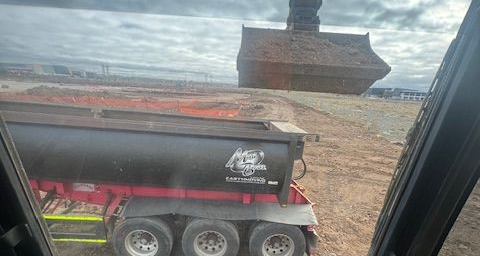
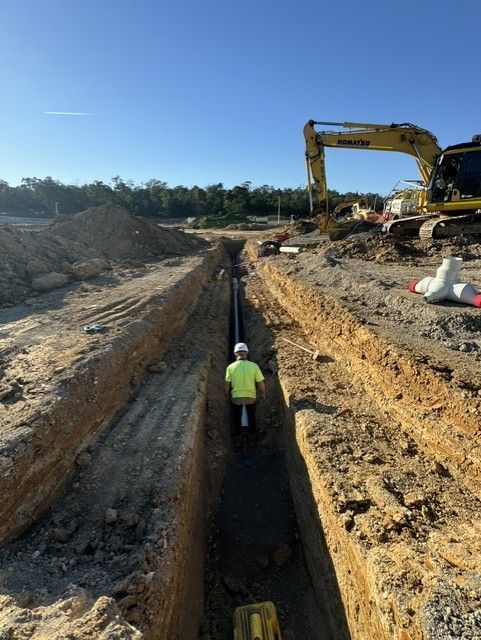
Ask most people how you move dirt off a site faster and they'll point at the truck. Get a bigger one, do fewer trips. On real earthmoving jobs around Melbourne, though, the bigger gains often come from how the material is carted, not just how much fits in the tray. Efficient spoil removal is one of the quiet levers that keeps a bulk earthworks program on time, and the trailer doing the carting has a lot to do with it. The photo above shows exactly that: one of our excavators loading a side tipper on a growth-corridor site, ready to run spoil off site without the stop-start of a conventional setup.
What the photo shows
It's a straightforward loading shot with a lot going on underneath it. An excavator sits over a side tipper trailer, dropping bucket loads of excavated material in ready to cart away. The site is a growth-corridor development on Melbourne's fringe, the kind of open, high-volume job where a lot of soil has to leave the ground before levels are right and the build can move on.
The interesting part is the trailer. It's a side tipper, and on a job like this it does something a standard truck and dog can't.
The hidden cost of stop-start cartage
On a bulk earthworks job, the excavator loading spoil is rarely the bottleneck. The bottleneck is the cart: how quickly each truck can take a load, get it off site, empty, and come back for the next one. Any dead time in that loop multiplies across a full day and a full fleet.
A conventional truck and dog carries plenty, but to empty it the driver has to stop, raise the body, wait for the load to slide out, lower it again and move off. Each of those tips is a pause. On a tight or busy site, trucks can end up queuing to tip, and while they wait, nothing is being carted. That's time the machines are running and the clock is ticking, with no material actually leaving the site.
How a side tipper changes the maths
Tipping on the move
A side tipper empties differently. Instead of coming to a stop and lifting the whole body, it discharges the load out to the side, and it can do it while still rolling. There's no need to halt, tip and reset before the next run. The load goes out, the trailer keeps moving, and the truck is straight back into the cycle.
Take the stopping out of the tip and you take a chunk of dead time out of every single load. Over a day of continuous cartage, that's the difference between a site that keeps flowing and one that spends half its time waiting on trucks.
Fewer idle machine hours
Faster turnaround on the cart does more than move dirt quicker. It keeps the excavator working instead of sitting with a full bucket and nowhere to put it. On earthmoving jobs, idle machine hours are pure cost: fuel, operator time and hire all ticking over while nothing productive happens. Tighten the cartage loop and the whole site runs leaner.
Where side tippers earn their keep around Melbourne
Not every job needs one. For a small residential cut, a more compact setup makes better sense. Side tippers come into their own where there's real volume and room to work.
That describes a lot of what's happening on Melbourne's edges right now. Growth-corridor suburbs to the north and south-east are in constant build mode, with subdivisions, civil works and commercial sites all shifting large quantities of material. On those jobs, spoil removal is often the pace-setter, and an efficient cart method pays for itself over the life of the works.
It's the same thinking whether it's a subdivision, a commercial pad or a civil earthworks program. You can see the range of civil and earthmoving work we take on across our projects, from open growth-corridor sites to tighter established suburbs.
The cart is part of the earthworks, not an afterthought
There's a habit of treating spoil removal as the boring bit at the end, something to sort out once the digging is under way. On a well-run job it's planned from the start. How much material is leaving, where it's going, what gear carts it and how the trucks flow in and out of the site all get worked out before the first bucket comes out of the ground.
That's where running the earthmoving and the transport together matters. When the same team scopes the excavation and the cartage, the two are matched to each other rather than bolted together on the day: the right trailer for the volume, the right number of trucks for the cycle, and a loading setup that keeps everything moving. Our earthmoving and transport work is built around that kind of coordination, so the material coming out of the ground has somewhere to go without holding up the dig.
Planning spoil removal on a Melbourne earthworks job
If you're pricing or planning a job with a lot of material to move, it's worth thinking about the cart as early as the dig. The volume of spoil, site access, where it can be tipped and the gear used to move it all shape how long the job takes and what it costs. Get that right and a big earthworks program stays on schedule. Get it wrong and the machines end up waiting on trucks.
CHS has run earthmoving and civil earthworks across Melbourne for over 30 years, alongside the landscaping and horticultural side of the business. If you've got a site with spoil to shift, get in touch for a free quote and we'll take a look at what it needs.
Frequently Asked Questions
What is a side tipper and how is it different from a truck and dog?
A side tipper is a trailer that empties its load out to the side rather than lifting the whole body to tip from the rear. The main practical difference is that it can discharge while moving, so it doesn't have to stop, raise and reset to empty the way a truck and dog does. On high-volume cartage that removes a lot of dead time from each load.
Why does spoil removal affect how long an earthworks job takes?
On bulk earthworks the excavation is often faster than the cart. If trucks are slow to turn around or end up queuing to tip, the machines can be left waiting with nowhere to put the material. Efficient spoil removal keeps the excavator working and the site flowing, which is usually what sets the overall pace.
Do you only use side tippers on large sites?
No. The right cart method depends on the job. Side tippers suit high-volume work with room to operate, such as subdivisions and growth-corridor sites, while smaller or tighter jobs are often better served by other gear. Matching the method to the volume and the access is part of scoping the work.
Do you handle earthmoving across Melbourne's growth corridors?
Yes. We regularly work on growth-corridor and civil sites around Melbourne, as well as established inner and eastern suburbs. Large-volume earthmoving and spoil cartage is a core part of what we do alongside the garden and landscape side of the business.
Can CHS manage both the excavation and the spoil cartage?
Yes. Running the earthmoving and the transport together means the dig and the cart are planned as one job, so the material has somewhere to go without holding up the excavation. It's generally more efficient than treating the two as separate trades.